



Whether you're a first-time tenant or an experienced South African landlord, understanding exactly when rent is legally due - and how escalations and increases work - is essential. Getting this wrong can lead to legal disputes, lost rental income, or even an unlawful rent increase claim. This guide covers the legal framework, notice periods, letter templates, and practical advice from Rawson Property Group to keep both landlords and tenants on solid ground.
Quick answer: when is rent legally due in South Africa?
Rent in South Africa is due on the date specified in the lease agreement. Most written lease agreements set rent as payable on or before the 1st of each calendar month, in advance. This due date, along with the rental amount and payment terms, is binding on both parties for the duration of the lease.
Without a written lease, common law assumes rent is payable monthly in advance on the first day of the rental period. A landlord cannot unilaterally change the due date during a fixed term lease - any change must follow the lease and comply with the Rental Housing Act and the Consumer Protection Act.
Key differences at a glance:
- Fixed term lease: Rent due on the agreed date each month; amount and due date locked for the term unless an escalation clause applies.
- Month to month leases: Rent remains due on the original date; changes require proper written notice.
- No written clause: Common law default applies - first day of the rental period, monthly in advance.
Rawson Property Group advises both landlords and tenants to insist on a written lease agreement so there is no uncertainty about when to pay rent or how much is owed.
Key rental laws that govern when rent is due and when it can increase
Several pieces of legislation create the legal framework for rental relationships in South Africa. Understanding these key rental laws is essential for anyone in the rental market.
The Rental Housing Act, 1999 (as amended) is the core statute. It governs lease agreements, sets minimum standards, requires prompt and regular payment of rent, and establishes the rental housing tribunal as a dispute resolution forum in each province. The Rental Housing Act and the Consumer Protection Act together govern rental terms in South Africa.
The Consumer Protection Act, 2008 (CPA) applies to fixed term lease agreements longer than six months. It regulates notice periods, fairness of lease terms, and gives tenants the right to early termination with 20 business days' notice subject to a reasonable cancellation penalty.
South African common law of lease (locatio conductio rei) fills gaps where the lease is silent - including default assumptions about when rent is due and how rental agreements are interpreted.
There is no national statutory cap on rent increases under South African law, and there is no maximum percentage limit for rent increases. However, increases must be reasonable, market-related, and compliant with the lease and the CPA. Provincial Rental Housing Tribunals apply these rental laws when deciding disputes about arrears, due dates, and questioned rental increases.
What your lease agreement must say about rent due dates
The lease agreement is the primary source for determining when rent is legally due. A lease agreement must include essential details like the rental amount, and every written lease should clearly cover:
- The monthly rent and when it is due (e.g. "on or before the 1st of each calendar month, in advance")
- The payment method and account details
- Annual escalation percentage, review dates, and how much notice the landlord must give before a rental increase
- The security deposit amount and confirmation that the landlord must keep deposits in an interest bearing account
Any escalation clause must be clear, unambiguous, and consistent with the CPA and Rental Housing Act to be enforceable. If the wording is vague - such as "reasonable increase as market dictates" - courts may strike it down.
Verbal lease agreements are legally binding in South Africa, but a written lease is recommended to avoid misunderstandings. Written lease agreements help prevent misunderstandings and disputes. Rawson Property Group strongly recommends a comprehensive written lease agreement to protect both parties.

When is rent due on different types of leases?
The timing of rent payments can differ across lease types, even though the underlying south african law principles are similar.
- Fixed-term residential leases (12 or 24 months): Rent is due monthly in advance on the fixed calendar date stated in the lease. The rental amount and due date cannot change during the term unless the lease contains a specific clause allowing it.
- Month to month leases: Rent usually remains due on the same day established in the original lease. Changes, including rent increases, require at least one full calendar month's written notice.
- Student or holiday rentals: Some require weekly or upfront term payments. These must be clearly stipulated in the lease.
- Commercial and industrial leases: Rent is often due monthly in advance with annual escalations linked to CPI or a fixed percentage. Rawson Property Group manages commercial rental agreements with these structures across South Africa.
Regardless of lease type, rent is legally due when the contract says it is - unless the clause is unlawful or unfair under the CPA.
Rent escalations and rent increases: how and when they can happen
It's important to distinguish between an escalation (a pre-agreed annual percentage increase built into the lease) and a discretionary rent increase proposed at renewal or on a periodic basis.
During a fixed term lease, landlords and tenants are bound by the agreed escalation clause. A landlord cannot increase rent without prior agreement or notice, and rent increases must adhere to the lease agreement terms in South Africa. If there is no escalation clause, the rental amount stays fixed for the entire term.
In practice, residential rent escalations often fall in the 5–10% per year range. A 10% annual increase is generally considered reasonable by industry standards, consistent with High Court rulings that have upheld clearly worded escalation clauses at this level.
What makes a rent increase potentially unlawful? Any rent increase must be reasonable and justified - a drastic hike disconnected from comparable properties or imposed without agreed notice can be challenged. Rent increases must be fair, justifiable, and in line with market trends.
At renewal or on a month-to-month basis, increases must be communicated in writing. A landlord using a professional agency like Rawson Property Group can request a comparative market analysis to justify a proposed rental increase to the other party.
Notice periods: how much notice is required for rent increases and due-date changes?
Proper notice is crucial. Failure to provide written notice can make a rent increase unenforceable.
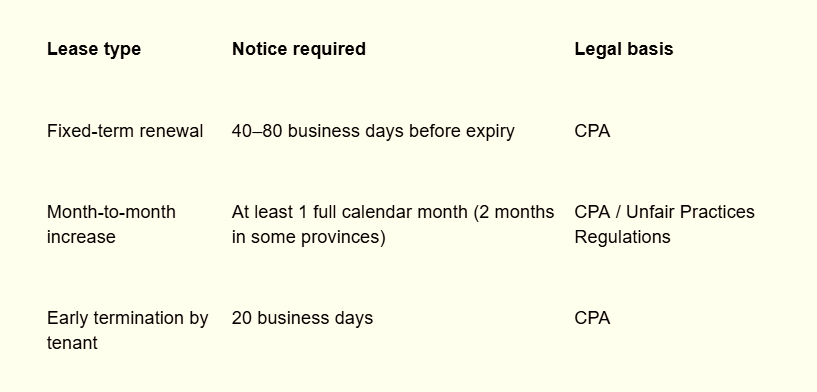
Landlords must provide written notice 40 to 80 days before the lease expires if proposing changes at renewal. The consumer protection act requires 20 business days' notice for certain material changes. Landlords must provide notice before implementing a rent increase - without it, a tenant may legally continue paying the old rent until requirements are satisfied.
Tenants can cancel a fixed term lease with 20 business days' notice, subject to a reasonable cancellation penalty. This right interacts with any pending rental increases, giving tenants an exit if new terms are unaffordable.
Changing the rent due date itself generally requires mutual consent or a proper amendment notice in line with the lease's variation clause.
Late payment, arrears and when non-payment becomes a breach
Once the contractually agreed due date passes without full payment, the rent is in arrears and the tenant may be in breach. It is the tenant's duty to pay rent on time every month.
Without a specific clause, rent is overdue immediately after the due date.
The typical breach procedure works as follows:
- The landlord sends written notice of breach, giving the tenant at least 20 business days to remedy (under CPA-compliant leases).
- If not remedied, the landlord may cancel the lease.
- Failure to pay notified rent can lead to breach of contract and eviction.
Landlords must follow legal procedures to evict tenants for non-payment or breach. The PIE Act governs eviction procedures in South Africa, and landlords must obtain a court order to evict. Tenants cannot be forcibly removed without following legal procedures - taking the law into your own hands through lockouts or cutting utilities constitutes illegal eviction. The eviction process can take several months to complete, and landlords must give tenants reasonable time to vacate the premises.
Deposits are typically equal to one or two months' rent. Landlords must keep security deposits in an interest bearing account, and tenants can request proof of the deposit account and interest earned. Upon lease end, landlords must return deposits within 14 days if repairs are needed, following a joint inspection and inspection report documenting normal wear and existing defects. Landlords must provide receipts for any deductions from the deposit.
Using a professional property manager such as Rawson Property Group can help landlords manage arrears and send compliant notices while avoiding unlawful practices.

Using the Rental Housing Tribunal when you disagree about rent due dates or increases
The rental housing tribunal operates in each province as a free, accessible forum to resolve rental disputes between landlords and tenants. A tenant can approach the Rental Housing Tribunal for dispute resolution on matters including:
- Disagreement over when rent is due
- Contested or unjustified rent increases
- Claims that a rent escalation is excessive or unfair
- Complaints about late payment penalties
Tenants can dispute an unjustified rent increase through the Rental Housing Tribunal, and tenants can challenge rent increases without notice at the Tribunal. To lodge a complaint, submit a written form with supporting documents - the lease, correspondence, and proof of payments. Typical outcomes include formal mediation, binding rulings on what rent is payable and from which effective date, or directives to amend lease practices.
Tenants can continue paying the undisputed portion of rent while a dispute is pending. Both parties should keep written records of all communications to support an amicable resolution or, if needed, further legal action. Rawson Property Group agents can guide clients on whether a case is appropriate for the Tribunal or requires separate legal remedies.
How to draft and send rent increase and escalation letters
Clear communication through proper letters protects landlords from legal disputes and helps treat tenants fairly. There are two main types:
- Annual escalation letter: Implements a pre-agreed clause in the lease (no negotiation needed, just notification).
- Discretionary rent increase letter: Proposes a new rental amount at renewal or on a month-to-month basis (requires adequate notice and may be negotiated).
Every rent increase letter should contain: tenant details, property address, current rent, new rent, percentage increase, effective date, legal basis (lease clause and applicable legislation), and confirmation of how much notice is being given.
Sample annual escalation letter
Dear [Tenant Name],
Re: Annual Rental Escalation - [Property Address]
In terms of Clause 5 of your lease agreement dated 1 July 2025, the monthly rental is subject to an annual escalation of 8%.
Your current monthly rent of R12 000 will therefore increase to R12 960, effective 1 July 2026.
Please ensure payment of the new rental amount on or before the 1st of each month to the account specified in your lease.
Should you have any queries, please contact your Rawson Property Group rental agent.
Kind regards, [Landlord / Agent Name]
Sample fixed-term to month-to-month transition letter
Dear [Tenant Name],
Re: Lease Transition to Month-to-Month - [Property Address]
Your fixed-term lease expires on 30 June 2026. As no new fixed-term agreement has been concluded, your tenancy will continue on a month-to-month basis from 1 July 2026.
The new monthly rental will be R13 500 (an increase of 7% on your current rent of R12 617). Rent remains due on or before the 1st of each calendar month. Either party may terminate this arrangement by providing one month's notice in writing.
Please confirm receipt of this letter.
Kind regards, [Landlord / Agent Name]
Letters should be sent via traceable means - email with read receipt, registered post, or hand delivery with acknowledgement. Copies should be retained in the rental file. Note that advertising costs and agent fees related to re-letting do not form part of the rent increase notice but may be relevant if the tenant refuses to renew.

Tenant responses: when can a tenant refuse a rent increase or escalation?
Many tenants wonder whether they can simply refuse a rent increase. The short answer: tenants must continue paying rent on the agreed due date, but may lawfully challenge increases that do not comply with the lease or legislation.
A tenant can legitimately refuse to pay the increased portion when:
- No proper written notice was given
- The increase takes effect earlier than the lease or law requires
- The escalation is clearly unreasonable or above market levels
- There is no escalation clause in a fixed-term lease and the landlord attempts a mid-term increase
Tenants should put objections in writing, reference the relevant lease terms and laws, and continue paying the undisputed rent on the usual due date. Tenants have the right to demand a receipt for rent payments made. Tenants cannot withhold rent to force landlords to perform maintenance - that is a separate issue requiring its own legal remedies.
If a tenant refuses to accept terms and respectful communication fails, either party can escalate to the Rental Housing Tribunal or seek due process through the courts. A court order is required before any eviction order can be enforced; the process requires correct procedures at every stage. Rawson Property Group encourages clear communication and balanced negotiation - many tenants and landlords reach agreement when both sides have proper legal knowledge.
Early termination, renewals and how they affect rent due dates
Early termination and lease renewals can change when rent is due, but only if properly managed under the CPA and the original lease.
Under the CPA, tenants may exercise early termination by giving 20 business days' notice, subject to a reasonable cancellation penalty. Rent remains due up to the termination date on the usual due date. Landlords should not be held liable for losses if correct procedures are followed.
Lease renewals or extensions should be documented with a new term, any change to the rental amount, an updated due date if applicable, and revised escalation clauses. If a lease expires and the tenant stays on with the landlord's consent, the agreement may convert to a month-to-month rental, with rent still due on the same calendar day unless agreed otherwise.
Landlords should avoid "silent" renewals where increases are assumed but never clearly communicated - this is a common cause of disputes. Work through a professional agency like Rawson Property Group to manage renewals and early terminations so that lease terms remain clear and enforceable.
Practical tips from Rawson Property Group for landlords and tenants
Rawson Property Group is a full-service south african real estate brand experienced in residential, commercial, and industrial rentals across the country.
For landlords:
- Always use a written lease and clearly state rent due dates and escalation terms
- Provide tenants with generous written notice of increases - more than the minimum where possible
- Keep detailed records of notices, payments, and interest earned on deposits
- Never resort to self-help remedies; always follow the eviction process through the courts if a tenant refuses to vacate
For tenants:
- Read and understand your lease before signing - pay attention to escalation clauses and payment terms
- Diarise rent due dates and escalation dates so you are never caught off guard
- Query any unclear increases immediately with respectful communication
- If you believe a rent increase or due-date change is unlawful, seek advice before withholding payment
Rawson Property Group agents can help structure market-related rental increases, draft compliant rent increase letters, and mediate discussions when rental disputes arise. Knowing when rent is legally due - and following the correct procedures for escalations and increases - protects both landlords and tenants and supports stable, long-term rental relationships. Whether you need to provide tenants with a compliant notice or challenge an unfair increase, professional guidance makes all the difference.


